
Client: College of Charleston Magazine. Assignment: Andrew Austen ’20, adaptive golfer. The Links at Stono Ferry, Hollywood, SC
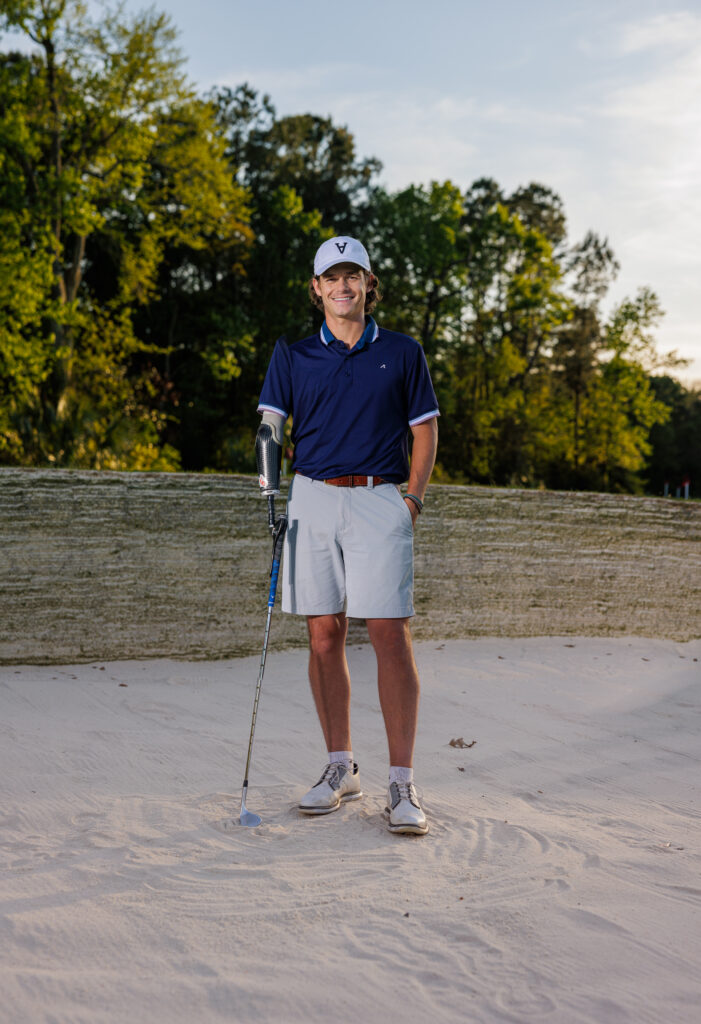
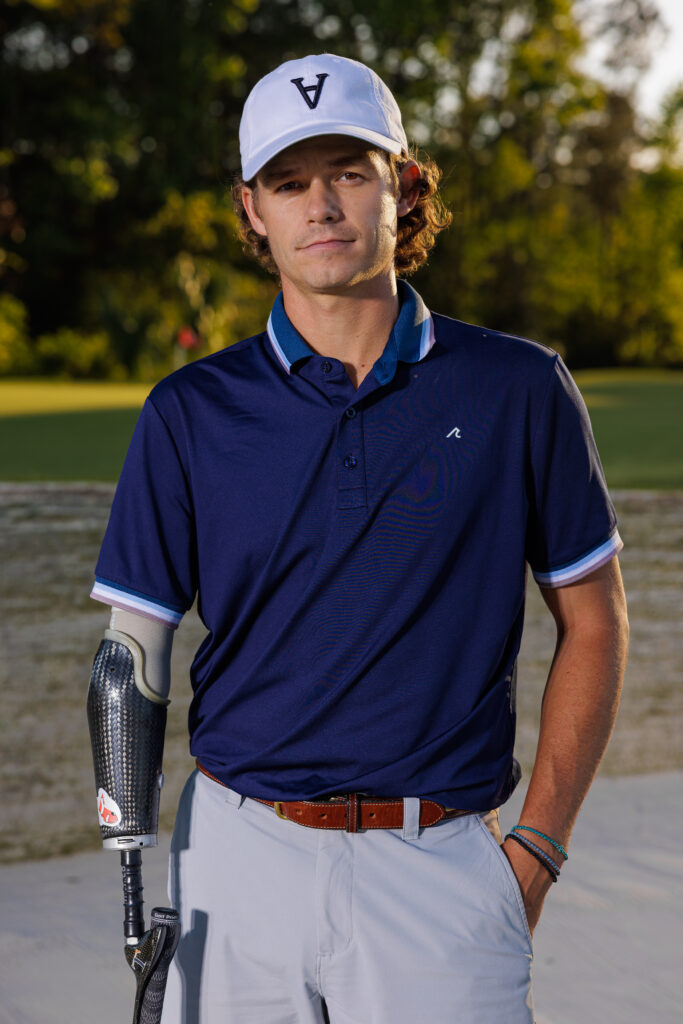
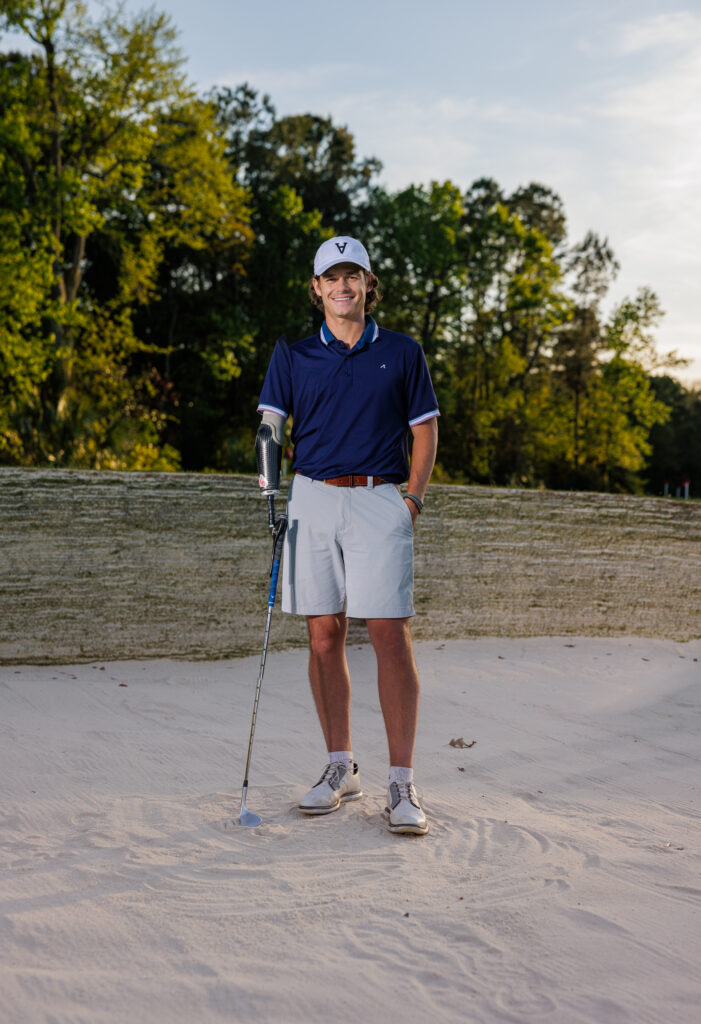
The image the magazine ran is Andrew Austen standing in a sand trap at Stono Ferry, hands relaxed, looking into the camera. His prosthetic and the club attachment are fully visible in it, and neither one is what the picture is about.
That was the whole problem to solve, and it was solved before I got to the course.
The Assignment
College of Charleston Magazine had a story for the Alumni Notebook about Andrew Austen, class of 2020, who had just qualified for his second U.S. Adaptive Open. Jennifer Hitchcock, the magazine’s art director, sent a brief that was specific and short. One horizontal hero image to run alongside text. No full bleed. Images due April 15. Andrew on a golf course.
Andrew was born without a right hand and forearm. He wears a silicone sleeve that locks into a carbon fiber socket, and a clamp slides up the club and tightens over the grip. He played baseball and basketball growing up, pitched in a district championship game his senior year of high school, and picked up golf seriously during the pandemic. He now coaches middle school athletes at Porter-Gaud and has built an audience of roughly 46,000 people on Instagram.
I called him before the shoot. That call decided most of what happened on the course.
The Story Was the Arm. The Photograph Was the Athlete
The magazine assigned a story about an adaptive golfer. Andrew’s missing hand and forearm is the reason the article exists. That was the writer’s assignment.
It was not mine. My assignment was a photograph of an athlete, and those two things pull in opposite directions if you are not careful about it.
There are two easy ways to get this wrong. Hide the arm, work the angles, shoot from his other side, and the picture quietly suggests there is something to be embarrassed about. Or go the other direction, build every frame around the prosthetic and the club attachment, and the golfer turns into a case study.
Talking with him first made the call obvious. He never had that arm, so he never missed it. He describes himself as an athlete before anything else, someone who wants to be the best at whatever he takes on and adapts to get there. He does not lead with the arm and he does not work around it. Neither should the pictures.
So the arm is visible in nearly every frame I delivered, and it is the subject of none of them.
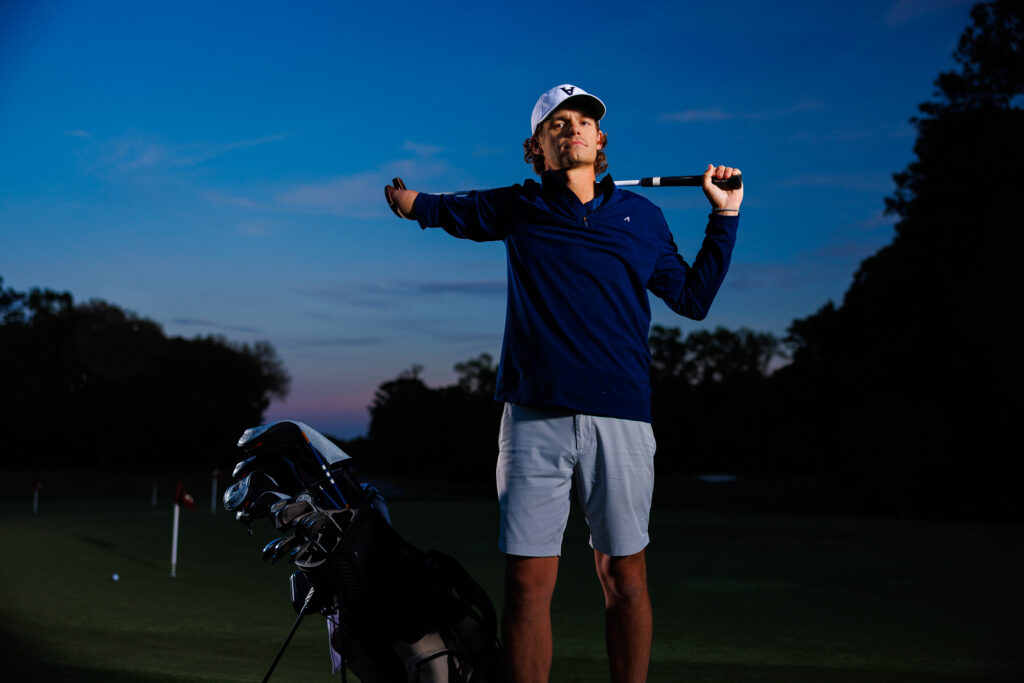
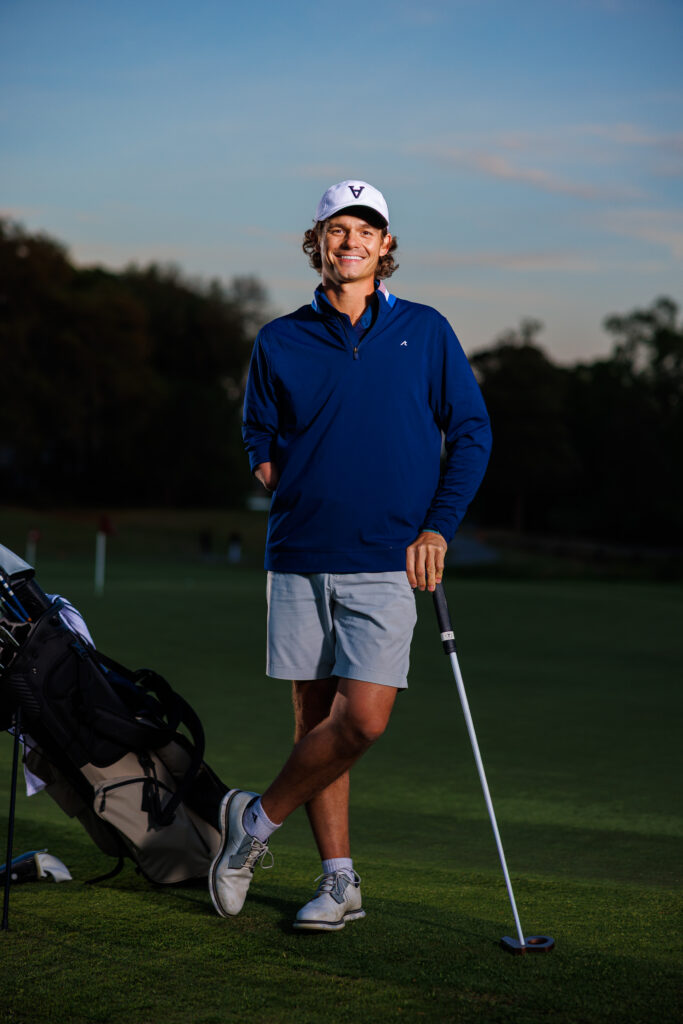
In one of the last setups he has the putter across his shoulders with both arms wrapped over it, the adapted side resting on the end of the club. Both arms are fully in view. The reason to look at the frame is the posture and the expression.
The lighting did the same work. On the sunset setups the main light sits at forty five degrees on his left, where you would expect it. The second light is at ninety degrees on his right, and it is there for one reason: to keep his right side and the adapted arm out of shadow. Letting that side go dark would have read as hiding it. Hitting it harder than everything else would have made it the point. It gets the same light the rest of him gets, and his face stays where the attention goes.
Nobody briefed that. There was no line in the assignment email about how to handle it. That judgment is the work, and it happens before I ever pick up the camera.
Four Setups
I got to the course an hour early to set up. Andrew was already at the driving range behind us, which is where he wanted to be anyway.
The Sand.
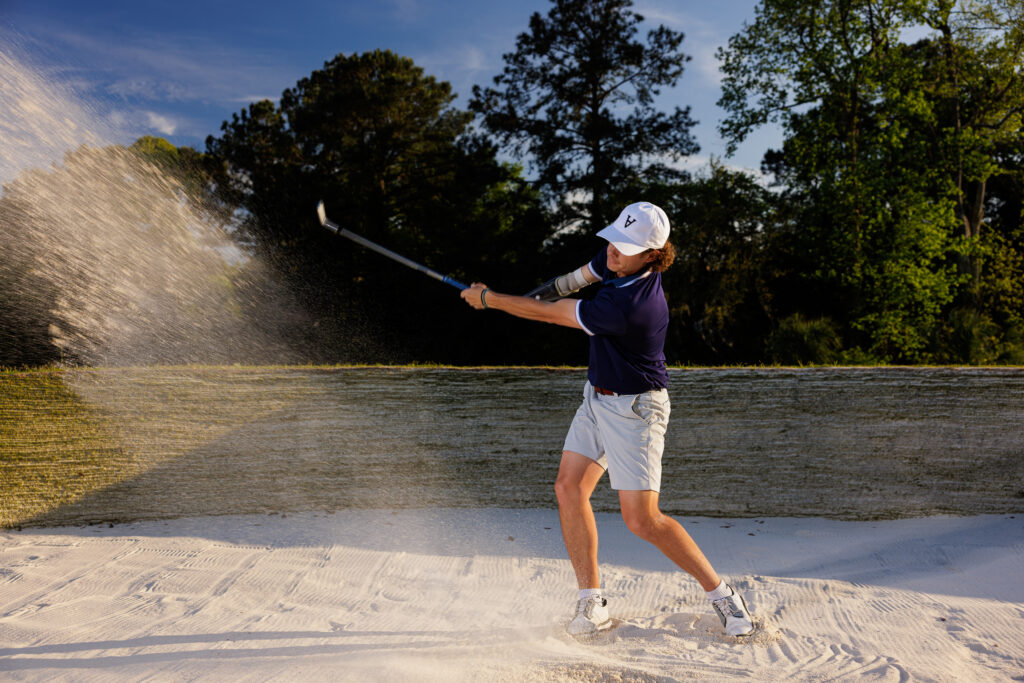
I combed the trap first so it would read as untouched, then texted him to come over. The first thing I asked for was the shot that ruins everything: a full swing out of the bunker, sand blasted straight into the camera and the lights. I wanted it in the can before anything else. It was the frame I was most confident would be the strongest of the day, and it was going to leave sand on me, on the gear, on everything. Get it first, and even if the rest of the day fell apart, I still had it.
The Standing Portraits.
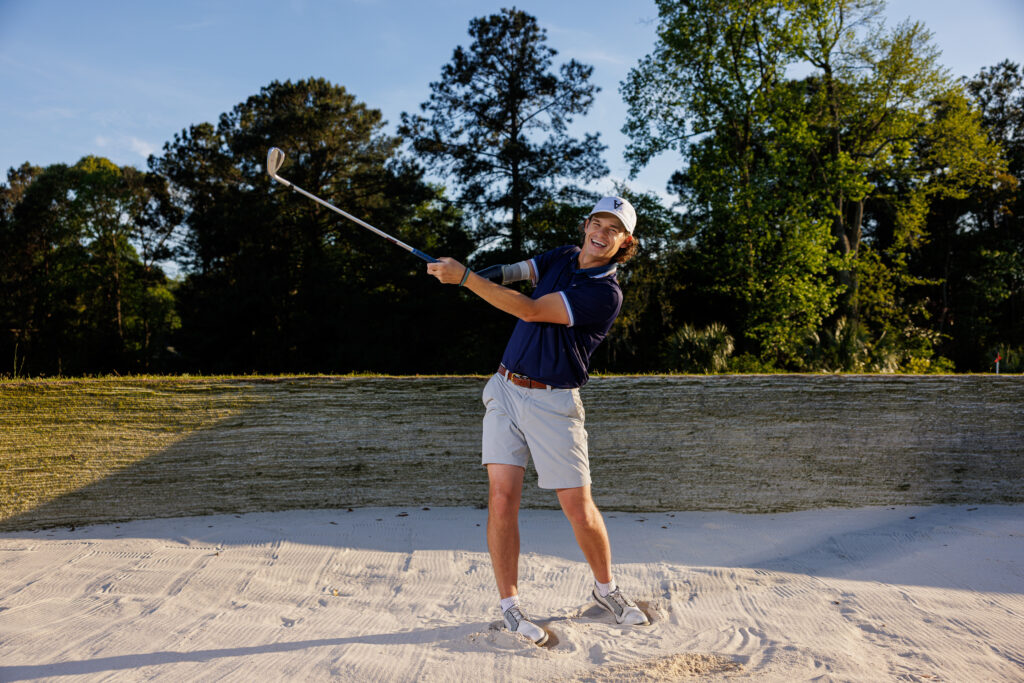
The sun was still high enough to sit behind his left shoulder and put a warm edge on him, so I moved in and worked closer. These are the quiet frames, no motion, and this is where the required image was going to come from. I shot each one twice: once with a direct, held look into the lens, once loose and laughing. Both registers, every setup, so layout could set whatever tone the page needed. The laughing shot is the one that ran in the magazine.
Overhead on the Green.
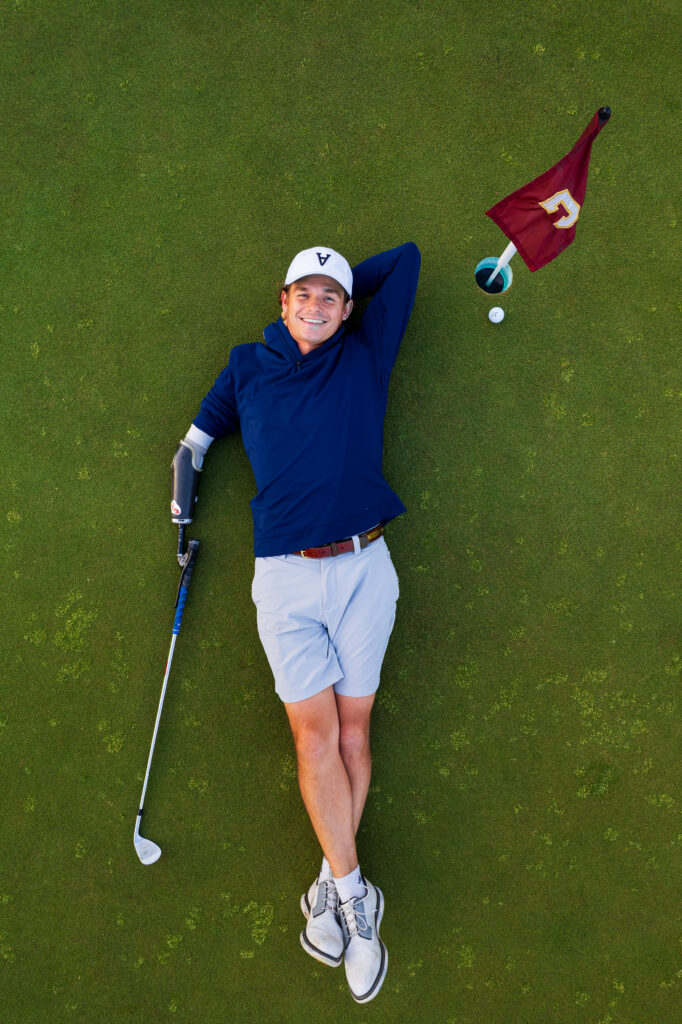
Andrew laid down beside the cup with a ball at the lip and the College of Charleston flag marker over his shoulder, wedge in the club attachment, left arm folded behind his head, looking straight up. I put the drone directly overhead. It is the one frame in the set with no tension in it at all, just an athlete lying on a green at the end of a good day. Editorial pages need a beat like that.
Last Light.
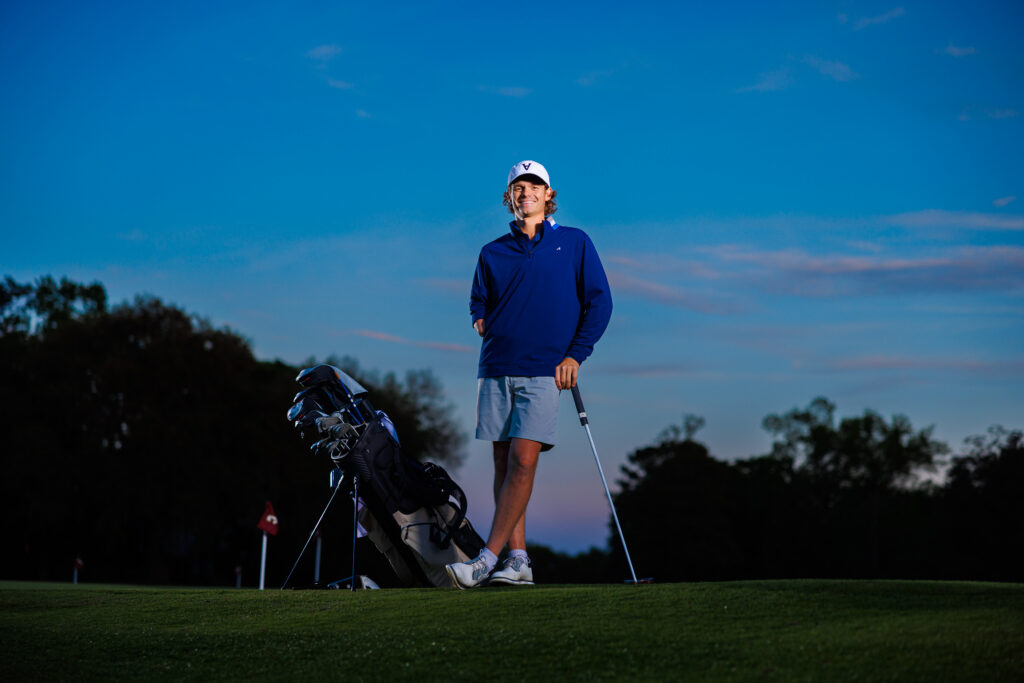
When the sun dropped behind the tree line, Andrew assumed we were finished. That is when the setup I had been waiting for became possible. The putting green sits up on a rise, and there is a gully running alongside it. I got down into the gully, roughly six feet below him, and shot up so his head and shoulders cleared the tree line entirely and sat against open sky. The color came in behind him, deep blue with red, orange and purple running through it, catching on the clouds above.
At some point he’d set the prosthesis down next to his bag. He asked if he should put it back on. I told him to leave it right where it was. That was the shot. Not because the moment needed a statement, but because that is exactly what the prosthesis is: a piece of equipment, same as the putter, same as the bag. It doesn’t belong on Andrew any more than any other tool he brings to the course. It belongs with the rest of the gear when he’s done using it.
These are the strongest frames from the day.
Why the Brief Is the Floor
The assignment called for one image. I delivered eleven images across four distinct setups.
That is not me overshooting. It is a working agreement built over almost fifteen years with Jennifer and this magazine. Layouts change. An article budgeted for one image gets more room once the issue comes together, or the page gets rebuilt and the frame that was chosen no longer fits the space. A single delivered image gives an art director no way to solve that without calling the photographer back.

This issue is the argument for it. The standing portrait ran with the article in the Alumni Notebook. A sand frame ran on the contents page to flag the story. Two placements, one shoot, and the second one came from an image nobody asked for.
What This Has to Do With Your Next Shoot
Every subject carries something they’d rather the camera not find. Most of the time the instinct, mine included, is to manage it out of frame. Andrew is the clearest reminder I’ve had that the better photograph usually comes from the opposite move.
If your next shoot puts a real person in front of a camera and the picture has to do more than fill a space, that is worth a conversation.


Share Post: